
The article, COP: 30 Years of Disillusionment, stands out among the thousands of pages written about the UN Climate Change Conference. It analyzes the danger posed by the COP apparatus itself, which prevents movements from imagining and fighting for systemic transformation. “Our task is not to reform the COP. Our task is to outgrow it – to build something that cannot be contained. To redirect our resources away from convention halls and toward struggles on the ground.
Other information

A recent report on the transnational corporation SOCFIN – owned by the French group Bollore and the Hubert Fabri family of Luxembourg – exposes the sexual violence, expulsions of local populations, and the contamination suffered by communities living around rubber and oil palm plantations. Socfin is an agri-food company with operations in 10 countries in the Global South. It controls approximately 380,000 hectares of land where it grows oil palm and rubber trees on an industrial scale.

“This manifesto is our roadmap in this decisive moment, the pulse of collective action, a call for profound systemic transformation.” With these words, La Via Campesina calls for people to read the demands they set forth in the “Via Campesina Manifesto for COP30” and, even more importantly, for readers to turn these demands into coordinated actions.

A group of grassroots communicators traversed “seas, rivers, jungles, valleys, plains, and, of course, indigenous communities, in five states of the Mexican Republic” to document the impacts of three megaprojects in Mexico: The Maya Train, the Morelos Integral Project and the Interoceanic Corridor.

Can the World Bank use the urgency of the climate crisis as an excuse to favor the same financial and corporate interests that have caused the crisis? The answer is yes, as shown in the report "Climatewash: The World Bank's Fresh Offensive On Land Rights," published this year by the Oakland Institute. The report takes an in-depth look at the World Bank's Global Program for Land Tenure Security and Land Access for Climate Goals, launched in 2024.

The new report from GRAIN shows how IT corporations like Meta, Microsoft and Amazon are turning to carbon markets to hide their ballooning greenhouse gas emissions, caused in large part by the industry’s push for increasing use of energy-heavy AI and cloud computing. GRAIN’s research looks at how in particular Amazon and the USD 10 billion Bezos Earth Fund set up by Amazon co-founder Jeff Bezos don’t stop at just buying carbon credits. Both are involved in creating the infrastructure to produce carbon credits.

Since the Paris Agreement, tree plantations have proliferated as purported carbon sinks and generators of carbon credits. This is a lucrative business that is also used to clean up the image of large companies. A recent article by Climate Tracker reveals some of the dirty ways companies use tree plantations to ironically promote themselves as clean. The cases come from Paraguay and Colombia. In the former, Apple uses monocultures that it presents as “forests,” in which it uses agrochemicals that are banned or restricted in other countries.

The Norwegian government through its state Pension Fund, has been a key investor in REDD-type projects, including monoculture tree plantations. Norway joined back in 2000 the World Bank´s Prototype Carbon Fund (PCF) that helped the Plantar company in Brazil to expand its eucalyptus plantations to profit from selling carbon credits.
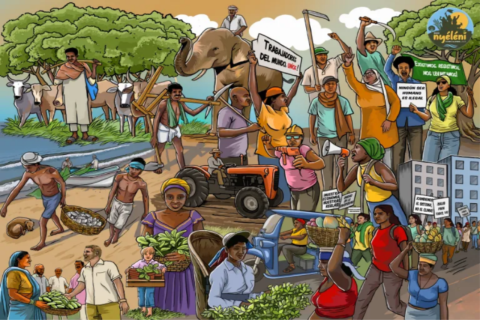
The Nyéléni Global Forum is one of the largest and most diverse gatherings of grassroots movements in the world, bringing together organizations of peasants, indigenous peoples, traditional fisherfolk, rural workers, and feminist and environmental movements, among others. Its main goal is to strengthen the global movement for food sovereignty. The third edition of the Nyéléni Global Forum was held in Kandy, Sri Lanka, from September 6-13, 2025, and it brought together almost 700 delegates from more than 100 countries.

The report, “Energy Alternatives: Surveying the Territory,” published by The Corner House, presents data and arguments that dismantle the thesis of the “green energy transition.” It also offers an extensive compilation of community experiences that propose energy alternatives based on a conception of energy that differs from the capitalist one. Access the report here (available in English and Spanish).
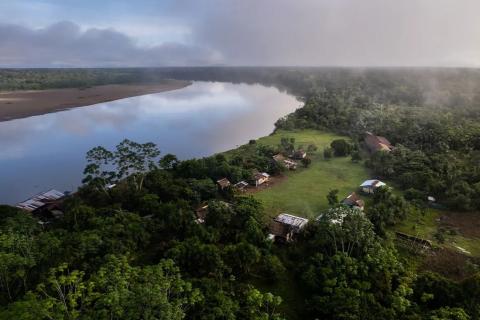
This article is a scathing critique of the climate policies developed in international negotiations, such as the COPs, which only serve the economic interests of whose who are accelerating destruction on the planet. In the name of such policies, 'carbon biopirates' threaten diverse indigenous communities and their territories throughout the world. “In the face of this daunting landscape, Indigenous Peoples are not only resisting, we are also proposing alternatives,” the article states.
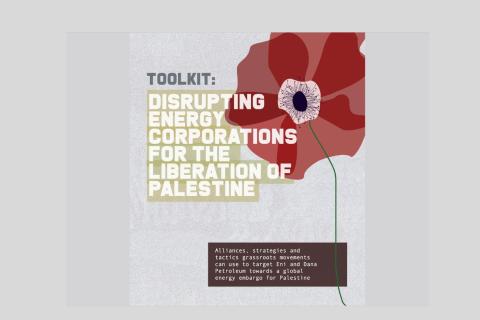
Energy corporations are constantly profiting from activities that fuel and finance Israel's colonial regime of apartheid and genocide against the Palestinian people. That is what stands out in the toolkit recently published by a global coalition from both within and beyond the region. Focusing on two particular corporations – Eni and Dana Petroleum, which in October 2023 were awarded gas exploration licenses from Israel in Palestinian waters – the publication is helpful to understand why energy is a critical issue in the struggle for Palestinian liberation.