On the first days of this month the Tasmanian people got to know of a deal that had been struck four months before between their government and the timber company Gunns. The deal, called the Sovereign Risk Agreement, provides that taxpayers should fund the company along 20 years with $15 million in case its wood supply is compromised by any reason. (1)
Other information
Biofuels – bio-diesel oil extracted from plants to replace high cost fossil fuels – have become controversial as the biofuel plantations are taking away lands mainly used, in particular for food production, by local communities.
In Burma, the ruling military junta has embarked on a massive expansion of biofuel plantations through forced confiscation of lands as well as arrests, fines, and beatings of farmers.
In November 2007, several representatives from World Rainforest Movement visited Komatiland Forests' operations at Brooklands in Mpumalanga province in South Africa.
By the WRM
The CBD recognized in 1992 the “vital role of women in the conservation and sustainable use of biological diversity” and affirmed “the need for the full participation of women at all levels of policy-making and implementation for biological diversity conservation” (Preamble; paragraph 13).
In spite of that, women have remained as invisible as ever within the deliberations of the CBD’s conferences of the parties.
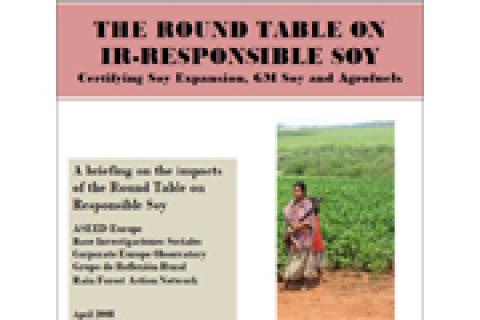
Certifying Soy Expansion, GM Soy and Agrofuels
ASEED Europe, Base Investigaciones Sociales, Corporate Europe Observatory, Grupo de Reflexión Rural, Rain Forest Action Network - April 2008
The Constituent Assembly formed to discuss and draft a new Ecuadorian Constitution resolved on 14 March 2008 to grant an amnesty to 357 human rights activists who had been “criminalized for their protest and resistance actions in defence of their communities and the environment,” according to an official press release. Most of the 357 are community and peasant leaders, some of them indigenous, from communities throughout the country.
Ghana: Norwegian biofuel company destroyed local forest to establish a large jatropha (1) plantation
Agriculture in Northern Ghana accounts for more than 90% of household incomes and employs more that 70% of the population in the region. Most of the agricultural production is by small-holders at subsistence level, reliant on seasonal rainfall which is unpredictable and sporadic. During the dry season much of the population is idle, forcing people to migrate to the more prosperous southern parts of the country where they are employed in menial jobs.
A recent study published by WWF (1) analyzes deforestation and forest degradation in Riau Province between 1982 and 2007 and identifies their main drivers: pulpwood and oil palm industrial plantations.
The study shows that the fastest rate of deforestation in Indonesia is occurring in central Sumatra's Riau province, which used to have 78% of its land covered by forest. In the past 25 years, some 4.2m hectares (65%) of its tropical forests and peat swamps have been cleared for industrial plantations.
Alan Garcia’s government is promoting a bill (draft law 840) also known as the “Forest Law.” It is a law concerning the promotion of private investment in reforestation and agro-forestry, whereby land with no forest cover in the Peruvian Amazon – erroneously classed as deforested wastelands, meaning there are no acquired rights over them – could be allocated, not as concessions, but as private property. This would open the door to major capital to establish large-scale tree plantations, under the guise of “reforestation.”
The world is undergoing an acute food crisis with soaring prices for basic food and desperate food-related riots that threaten political stability in many Third World countries. By the end of March, prices of rice and wheat were about double their levels a year earlier, and maize prices were over a third higher. According to FAO, the import bill for cereals for the world’s poorest countries will rise by 56% in 2007/08, after a 37% increase in 2006/07.

Press Release - 17 April 2008, International Day of Peasant's Struggle.
Asunción, Paraguay
FSC announced that its Accreditation Services (ASI) would be "conducting a Forest [sic] Management surveillance audit of SGS at Veracel in Brazil between the 26th-28th of March 2008". Within the framework of the evaulation process, the Social Environmental Forum of the Extreme South of Bahia was invited to take part in the Evaluation process, below their answer:
To Mr. André de Freitas,
Cc.: FSC-Brasil/FSC-Internacional